You have pain in your lower back, usually worse on one side. It might spread into your buttock, the back of your hip, or even your thigh. Some mornings it takes a few minutes just to stand up straight. You may have already been told it is a muscle strain, or that your sciatica is acting up, but nothing you have tried has kept the pain away for long.
In many cases like this, the structure causing the problem is not a disc, not a muscle, and not the sciatic nerve itself. It is the sacroiliac joint, and when it is not moving correctly, it can produce exactly that pattern of stubborn, one-sided lower back and hip pain that refuses to resolve on its own.
What Is the Sacroiliac Joint?
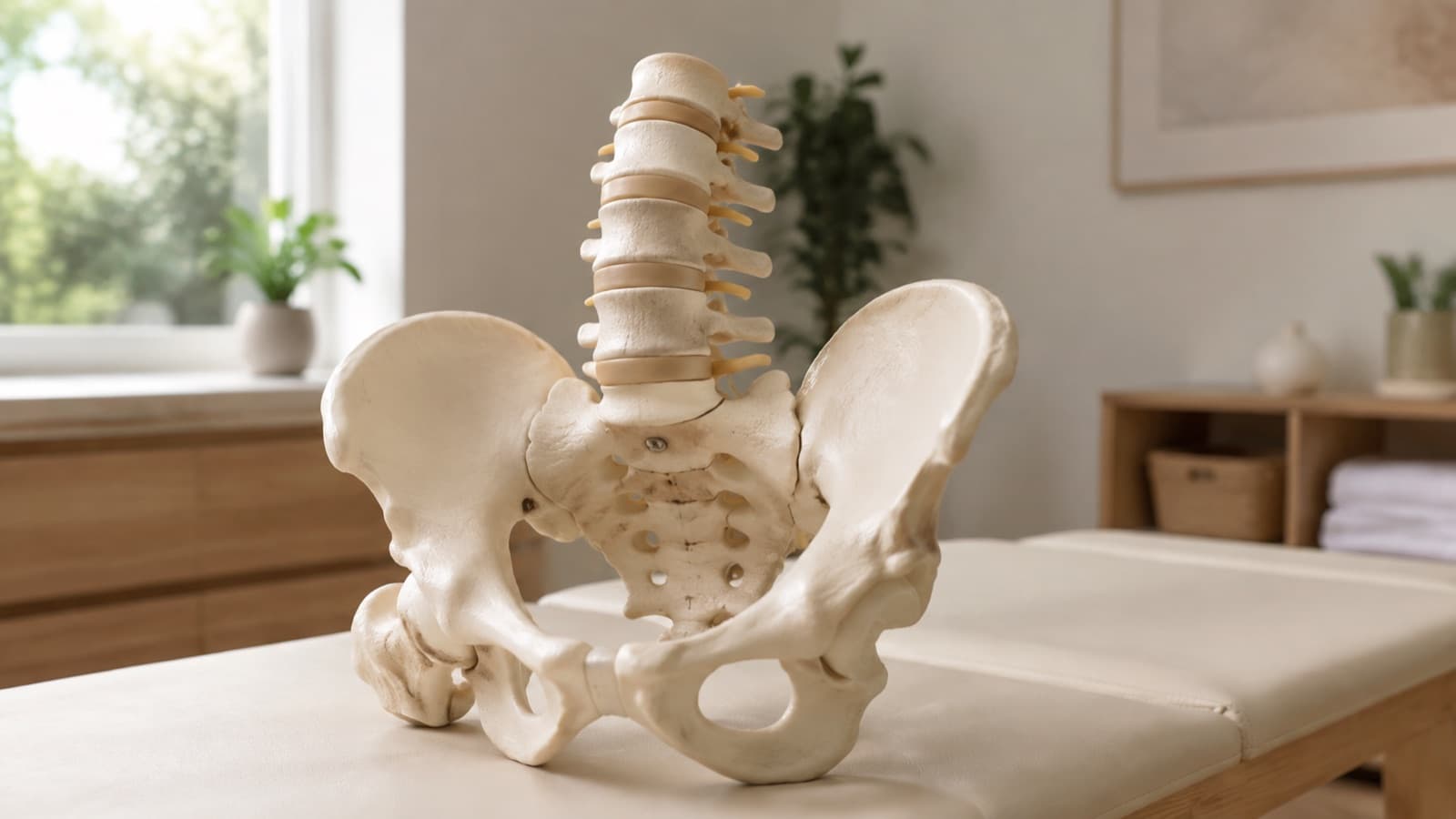
The sacroiliac (SI) joint connects the sacrum, the triangular bone at the base of your spine, to each side of the pelvis. You have one on the left and one on the right. These joints do not move very much, but the small amount of motion they do allow is essential. They act as shock absorbers between your spine and your legs, transferring force every time you walk, lift, climb stairs, or even sit down.
Because the SI joint sits right where the lower back meets the hip, problems there are frequently mistaken for something else. The pain can feel almost identical to a lumbar disc problem or sciatica, which is part of why SI joint dysfunction often goes undiagnosed or gets treated as the wrong thing for years.
Researchers estimate that SI joint problems account for roughly 15 to 30 percent of all chronic lower back pain cases. That is a large share of people who may be getting treatment aimed at the wrong structure.
What SI Joint Pain Actually Feels Like
The classic presentation is pain on one side of the lower back, often right at or just below the beltline. Some people feel it in one buttock. Others notice it in the back of the hip, the groin, or even down the back of the thigh to just above the knee. Rarely does SI joint pain go below the knee, which is one way it can sometimes be separated from true sciatica, though there is meaningful overlap.
A few patterns that point toward the SI joint rather than a disc or nerve root:
- Pain that is noticeably worse on one side only
- Stiffness and pain when getting out of bed in the morning or rising from a chair after sitting
- Sharp pain with certain movements, like putting your weight on one leg or rolling over in bed
- Pain that eases after you have been moving for a few minutes, then returns with prolonged sitting or standing
- Discomfort that runs into the buttock or upper thigh but not below the knee
None of these patterns on their own confirm an SI joint problem. An accurate diagnosis requires a physical examination by someone trained to test the joint specifically, because imaging alone often misses it. X-rays and MRI scans can detect severe degeneration but frequently appear normal even when the SI joint is the clear pain source.
What Causes SI Joint Dysfunction
The most common scenario is that the joint stops moving the way it should. It may become hypermobile, moving too freely, or hypomobile, where motion is restricted. Both situations produce pain, just through different mechanisms.
Common triggers include:
- Trauma. A fall onto one hip, a car accident, or a sports impact can shift the pelvis and stress the SI joint immediately or set the stage for dysfunction over time.
- Pregnancy and postpartum recovery. The hormone relaxin loosens the ligaments around the pelvis during pregnancy, which can allow the SI joint to move in ways it is not built to handle. This sometimes persists after delivery.
- Repetitive loading. Jobs or activities that involve prolonged asymmetrical postures, heavy lifting, or repeated one-sided movements, such as swinging a golf club, loading cargo, or standing on hard concrete, can stress the joint over months and years.
- Leg length differences. Even a small difference in leg length can shift the way force moves through the pelvis, gradually irritating one SI joint more than the other.
- Muscle imbalances. Tight hip flexors, a weak core, or gluteal muscles that are not doing their share of the work all change how the pelvis is held and how the SI joint is loaded throughout the day.
How Chiropractic Care Addresses the SI Joint
Chiropractic care is well suited to SI joint problems because restoring joint motion is exactly what chiropractic adjustment is designed to do. When the SI joint is not moving through its normal range, targeted manipulation can restore that motion, reduce the mechanical irritation on surrounding tissues, and allow the muscles and ligaments that support the joint to function more normally.
The adjustment for an SI joint problem is different from the adjustments used for mid-back or neck complaints. It typically involves positioning the patient on their side and applying a controlled, specific force to the pelvis. Patients who have had SI joint pain for a long time often notice an immediate change in how the joint feels, though relief usually builds over several visits as the joint stabilizes.
Adjustment alone rarely solves the whole problem. Muscle tightness in the glutes, piriformis, and hip flexors often accompanies SI joint dysfunction and keeps pulling the joint back toward the same pattern. Addressing those tissues directly, through soft-tissue work and dry needling if indicated, alongside targeted rehabilitation exercises that teach the muscles around the pelvis to do their job, is what makes results hold.
What to Expect at Mayfield Advanced Chiropractic
At Mayfield Advanced Chiropractic in Alexandria, Dr. Samuel Mayfield and Dr. Conrad Taylor take a root-cause approach to lower back and hip pain rather than treating symptoms in isolation. Their evaluation is built around understanding why the pain exists, not just where it exists.
Dr. Taylor holds a Master of Sports Science and Rehabilitation from Penn State and is certified in dry needling. For SI joint cases that involve significant muscle guarding or stubborn trigger points in the glutes or hip, dry needling is a tool that can reduce pain and allow the joint to respond more readily to adjustment and rehab work.
Rehabilitation exercises are integrated into care from early on. The goal is to build strength in the muscles that stabilize the pelvis and SI joint so that once motion is restored, it stays that way. Patients from Alexandria and the surrounding communities of Pineville, Ball, Boyce, Woodworth, Lecompte, Forest Hill, Tioga, Cheneyville, Bunkie, and Marksville come to the practice for this kind of structured, layered approach, which is built around real evaluation and patient education rather than indefinite passive treatment.
The practice philosophy, which they describe as Evaluate, Educate, Empower, Emerge, applies directly here. Understanding what the SI joint is, why yours is causing problems, and what specific steps you are taking to address it gives you a clear picture of your care rather than leaving you guessing from visit to visit.
Frequently Asked Questions
Can a chiropractor actually help an SI joint problem, or is this something that needs a surgeon?
The large majority of SI joint problems respond well to conservative care. Surgery for the SI joint exists but is typically reserved for cases where there is confirmed instability, structural damage, or degeneration that does not improve with any other approach, and those cases are a small minority. Chiropractic adjustment, dry needling, and targeted rehabilitation address the mechanical causes of most SI joint dysfunction without injections or procedures. If your evaluation suggests the problem goes beyond mechanical dysfunction, you will be told that clearly rather than pushed through care that is not appropriate for your situation.
How is SI joint pain different from sciatica?
Sciatica is pain that comes from irritation or compression of the sciatic nerve, usually from a disc problem or bone spur in the lumbar spine. It tends to run from the lower back all the way down the leg, often past the knee and into the foot, and it may come with numbness, tingling, or weakness in the leg. SI joint pain can feel similar in the buttock and upper thigh, but it typically does not travel below the knee and it does not produce the electrical or burning quality that nerve pain does. The two conditions can also coexist. Proper examination is what separates them, not symptom description alone.
How long does it take for SI joint dysfunction to get better with chiropractic care?
Cases that are relatively recent and straightforward often see meaningful improvement within three to six weeks of consistent care. Longer-standing problems, or cases where significant muscle imbalance or ligament laxity is involved, take more time and require more attention to rehabilitation alongside adjustment. The honest answer is that the timeline depends on findings from your actual evaluation. What stays consistent is the goal: not just reducing pain while you are being treated, but building the stability that keeps the joint working correctly after care ends.
Where is Mayfield Advanced Chiropractic, and how do I make an appointment?
The practice is located at 5419 Jackson Street Ext, Suite B, Alexandria, LA 71303. They see patients from Alexandria, Pineville, Ball, Tioga, Woodworth, Forest Hill, and communities throughout Rapides Parish. Same-day appointments are available for new patients. You can call the office at (318) 787-2708 to schedule an evaluation or ask about your specific situation before committing to an appointment.