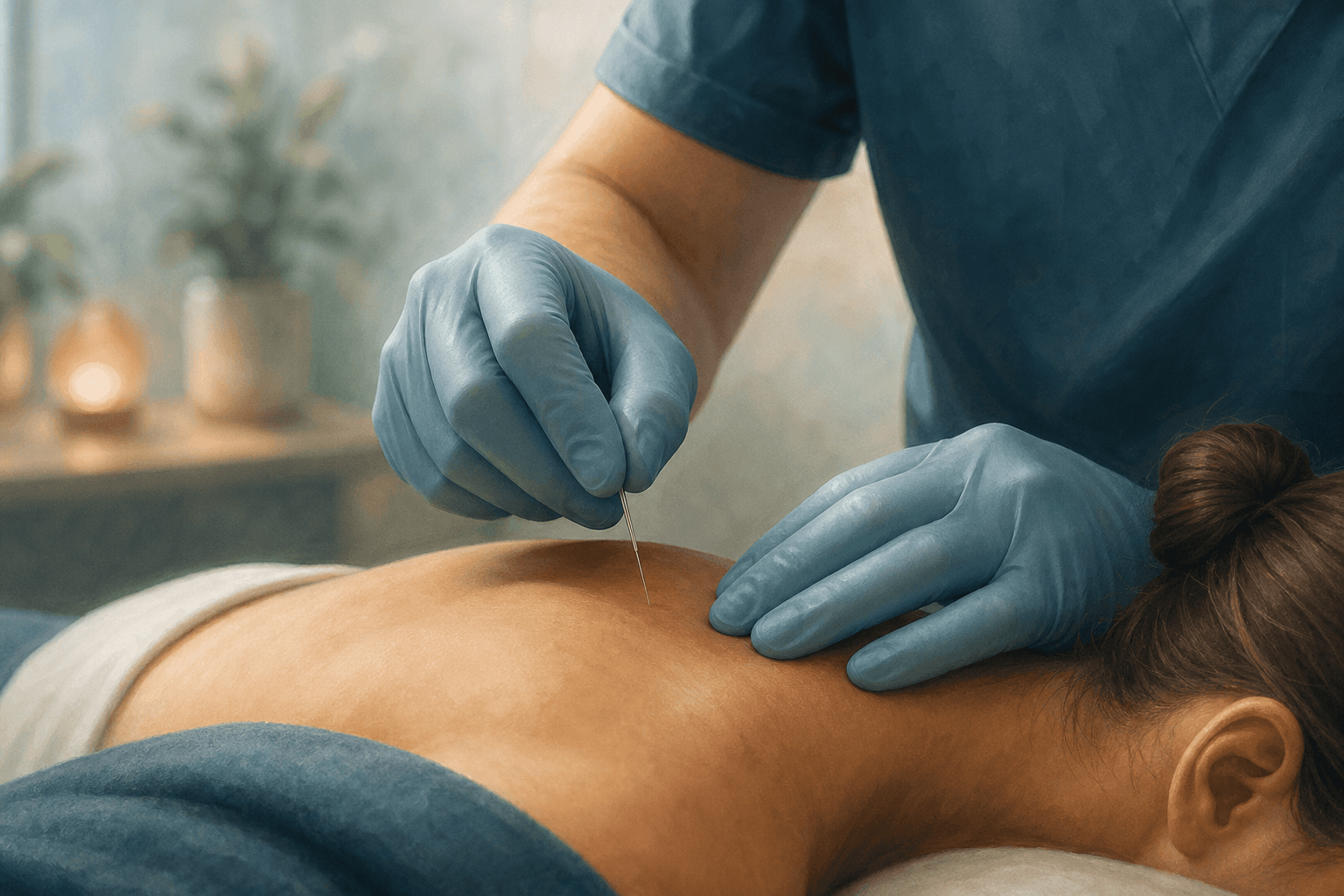
When patients in Alexandria hear "dry needling," the first question is almost always the same: is that acupuncture? Fair question — both involve very thin needles — but they are different tools doing different jobs. Understanding the difference makes it clear why dry needling has become one of the most requested treatments at Mayfield Advanced Chiropractic, where it is performed by certified providers.
The Short Version of the Difference
Acupuncture comes from traditional Chinese medicine and places needles along meridian points based on that system. Dry needling is a modern, anatomy-based technique: the provider palpates the muscle, finds the specific trigger point — a taut, irritable band of muscle fiber that refers pain and refuses to relax — and places a fine filament needle directly into it. "Dry" simply means nothing is injected; the needle itself is the treatment.
Why a Needle Can Do What Stretching Cannot
Trigger points are stubborn because they sit deep in the muscle belly, locked in a contraction the nervous system keeps reinforcing. Stretching pulls on the whole muscle; massage works the surface and surrounding tissue; but the knot itself often survives both. A needle reaches the exact spot. When it contacts the trigger point, the muscle typically gives a brief involuntary twitch and then releases — letting go of tension it may have held for months. Blood flow returns to the starved tissue, the pain-referral pattern quiets, and the muscle can finally move and strengthen normally.
What We Treat With It
- Neck and shoulder tension — the trapezius and levator knots behind desk-work and stress, including ones feeding tension headaches.
- Low back and hip muscle pain — glute and hip trigger points that mimic or aggravate sciatica-like symptoms.
- Chronic overuse problems — forearm, calf, and hamstring tightness that keeps limiting activity.
- Sports and work strains — muscles that stayed guarded long after the original injury healed.
How It Fits Into a Complete Plan
Dry needling releases the knot; it does not fix what built the knot. That is why, at Mayfield Advanced Chiropractic, it is paired with the rest of care — chiropractic work for the joints the tight muscle was protecting, and rehabilitation so the muscle rebuilds strength instead of re-tightening. Used that way, the release becomes a lasting change rather than a pleasant week.
What It Feels Like
The needles are hair-thin — most people barely feel the insertion. When the needle finds an active trigger point, you feel the characteristic twitch and a deep, brief ache or cramp sensation; that response is the release happening. Some soreness for a day afterward, like a good workout, is common. Sessions are quick and there is no downtime.
Frequently Asked Questions
Is dry needling safe?
Performed by trained, certified providers — as it is at Mayfield Advanced Chiropractic — dry needling is a safe treatment with sterile, single-use needles. The most common side effect is a day of mild post-treatment muscle soreness.
How is this different from getting a massage?
Massage works broad tissue from the surface; dry needling reaches the specific trigger point deep in the muscle that massage often cannot fully release. Many patients find the combination — release the knot, then restore the tissue around it — works better than either alone.
How many sessions will I need?
Some trigger points release meaningfully in one or two sessions; longstanding patterns usually take a short series alongside the corrective work that keeps them from returning. Your evaluation will give you an honest timeline for your case.
Where can I get dry needling in Alexandria?
Mayfield Advanced Chiropractic offers dry needling by certified providers at 5419 Jackson Street Ext, Suite B in Alexandria, Louisiana, serving Alexandria, Pineville, Ball, Woodworth, and Rapides Parish. Call (318) 787-2708 to schedule.