If you have been dealing with muscle pain, stubborn trigger points, or tightness that massage and stretching do not fully resolve, dry needling is a tool worth understanding. It is one of the more precise techniques available for releasing chronic muscular tension and restoring normal movement — and at Mayfield Advanced Chiropractic in Alexandria, it is part of a broader care model, not a standalone procedure.
Here is what dry needling actually is, how it works, who benefits from it, and what your first session looks like.
## What Dry Needling Actually Is
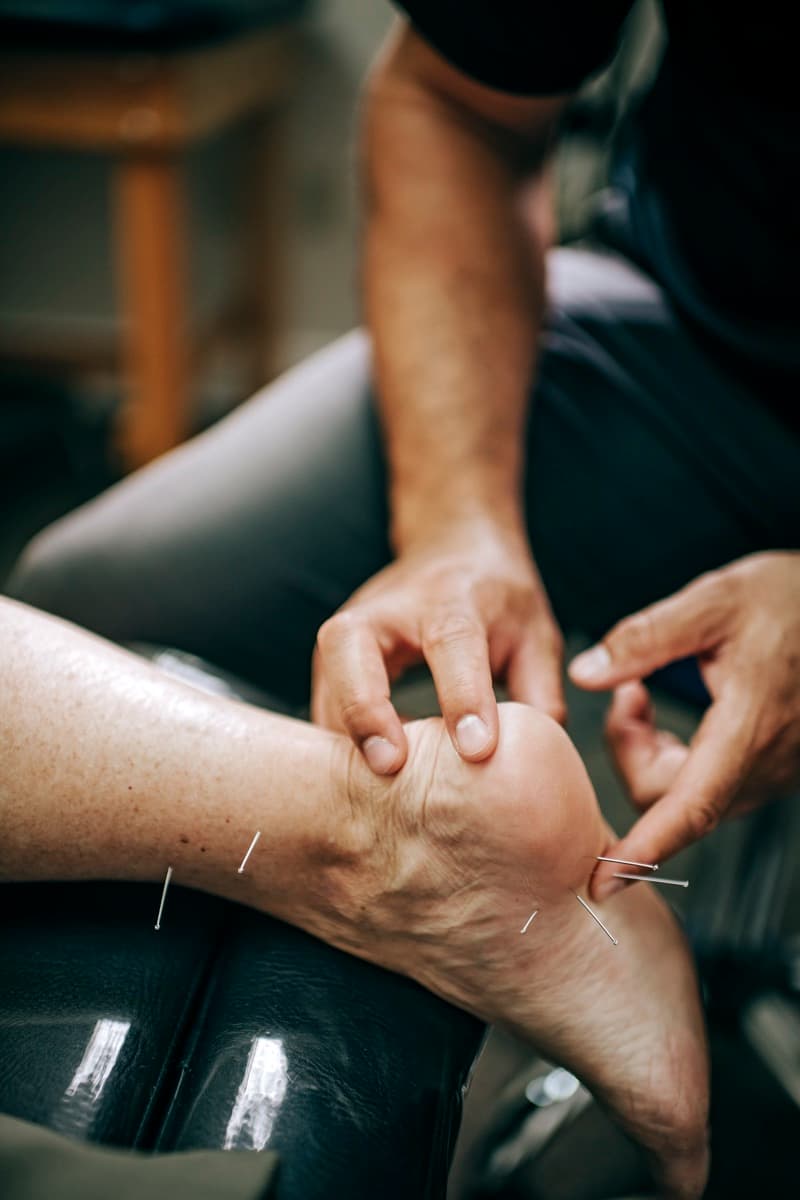
Dry needling uses thin, solid filiform needles inserted directly into a myofascial trigger point, a tight band of muscle, or an area of restricted tissue. The "dry" in the name means nothing is injected. The needle itself is the treatment.
When a needle contacts an active trigger point, it typically produces a local twitch response — a brief, involuntary contraction of the muscle band. That twitch is meaningful: it indicates the needle has found the dysfunctional tissue, and the response it triggers helps the muscle release its chronic shortening and restore normal circulation to an area that has been deprived of it.
The goal is to depolarize the tight band, interrupt the sustained contraction cycle, and create conditions for the muscle to return to a resting length it has not been able to reach on its own.
## How It Differs from Acupuncture
Dry needling and acupuncture use the same type of needle. That is where the overlap ends.
Acupuncture is a traditional Chinese medicine practice rooted in the concept of qi, meridians, and energy flow. Dry needling is a Western clinical technique grounded in anatomy, neurophysiology, and musculoskeletal medicine. Needles are placed at trigger points and dysfunctional muscle tissue identified by physical examination.
At Mayfield, dry needling is performed by Dr. Conrad Taylor — a former Division I athlete at Penn State, Logan College valedictorian, Big Ten Medal of Honor recipient, and holder of a master's degree in Sports Science and Rehabilitation with a specific dry needling certification. He approaches it as a precision tool within a structured plan, not a quick standalone fix.
## What Conditions Respond Well
Dry needling is particularly effective for conditions where muscular trigger points and chronic soft-tissue tension are driving or perpetuating pain. Common presentations we see in Alexandria:
- **Neck pain and tension headaches** — trigger points in the upper trapezius, suboccipital muscles, and levator scapulae are among the most frequent contributors, and they resist most stretching because the patient cannot voluntarily relax a muscle that is neurologically locked. - **Low back pain** — the thoracolumbar musculature, quadratus lumborum, and deep spinal erectors are common trigger point sites when chronic low back pain is primarily muscular rather than disc or joint driven. - **Hip and gluteal pain** — the piriformis and deep external rotators are involved in hip pain and sciatic-type symptoms that respond well to dry needling combined with targeted rehabilitation. - **Shoulder pain and rotator cuff tendinopathy** — trigger points in the infraspinatus and subscapularis are a common but underaddressed source of shoulder aching and weakness. - **Recovery from injury and sports performance** — for athletes and active patients, dry needling accelerates recovery of overworked or injured tissue by restoring normal muscle function and blood flow. - **Repetitive strain and desk-related pain** — long hours at a workstation or performing repetitive manual work creates predictable trigger point patterns that ergonomic changes alone often cannot resolve.
## What Happens at Your First Session
The first step at Mayfield Advanced Chiropractic is an evaluation — not a needle. Dr. Taylor or Dr. Mayfield will assess your movement, identify the muscles involved, and decide whether dry needling is the right tool and at what point in your care plan it makes sense to introduce it.
During the session itself, you will be positioned comfortably for access to the treatment area. The needles are very fine. Most patients describe minimal discomfort on insertion. The local twitch response when the needle contacts a trigger point can feel like a brief cramp or deep ache — that sensation is transient and is typically what patients notice most.
Sessions usually last 20 to 30 minutes depending on the area and number of sites. Some patients notice improvement within 24 hours. Many experience mild soreness in the treated area for a day or two afterward — similar to deep massage — which is a normal response.
Dry needling at Mayfield is integrated into a broader plan that may also include chiropractic adjustments, rehabilitation exercises, and therapeutic modalities. Treating the trigger point is the start of the process, not the finish line.
## The 4E Framework
Dr. Samuel Mayfield built Mayfield Advanced Chiropractic around four principles: **Evaluate, Educate, Empower, Emerge**. Dry needling fits within this model at the Evaluate-to-Empower stage — it removes a barrier that has been preventing the body from doing what it is capable of doing. The Empower phase — where patients learn to maintain and build on restored function through targeted exercise — is what produces the lasting outcomes.
That framework reflects Dr. Mayfield's 20-year military background, where discipline, process, and clear goals matter. It also reflects Dr. Taylor's athletic background, where performance is always the measured result.
## Frequently Asked Questions
## Is dry needling painful?
Most patients feel minimal discomfort on insertion. The local twitch response — a brief involuntary muscle contraction when the needle contacts a trigger point — can feel like a deep cramp for a second. Post-session soreness similar to deep massage is common for a day or two and is a normal response.
## How many sessions does it typically take?
This depends on how long the trigger point has been active and what else is driving the condition. Some patients notice meaningful improvement after two or three sessions. Chronic or multi-site presentations may require more. Dry needling at Mayfield is integrated into a full care plan rather than offered as a standalone service, which tends to produce faster and more durable results.
## Is dry needling the same as acupuncture?
No. Both use the same type of needle, but they are different practices rooted in different frameworks. Acupuncture works within traditional Chinese medicine. Dry needling is a Western clinical technique focused on myofascial trigger points and musculoskeletal anatomy. The application and intent are distinct.
## Who performs dry needling at Mayfield?
Dr. Conrad Taylor, who holds a dry needling certification and a master's degree in Sports Science and Rehabilitation, performs dry needling at Mayfield Advanced Chiropractic. He integrates it into each patient's broader care plan alongside Dr. Mayfield.
## Where is Mayfield Advanced Chiropractic in Alexandria?
We are at 5419 Jackson Street Ext, Suite B, Alexandria, LA 71303. Open Monday through Thursday 8:00 AM – 6:00 PM and Friday 8:00 AM – 12:00 PM. Call (318) 787-2708 to schedule an evaluation.