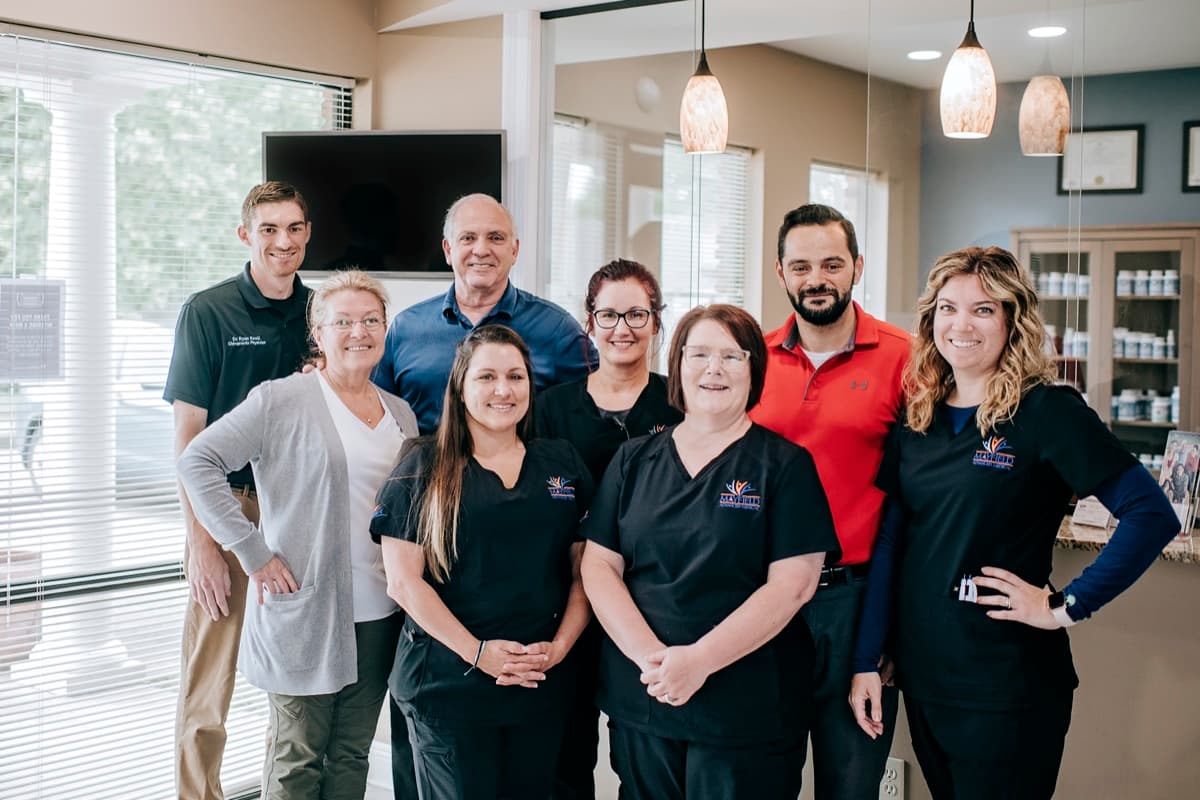
Shoulder pain is one of the more common reasons people come into Mayfield Chiropractic in Alexandria. The rotator cuff — the four muscles that stabilize the shoulder joint and allow it to rotate — is at the center of most of these cases, whether the issue is a full-thickness tear confirmed on MRI or a more functional pattern of rotator cuff strain and impingement without structural damage.
What's less widely understood is that the shoulder doesn't work independently. The cervical spine, the mid-back (thoracic spine), and the mechanics of the shoulder blade all directly affect how the rotator cuff loads with every arm movement. Treating the rotator cuff without evaluating those areas often leaves the underlying mechanical problem intact.
What the Rotator Cuff Does
The rotator cuff is made up of four muscles: supraspinatus, infraspinatus, teres minor, and subscapularis. Together, they hold the humeral head centered in the glenoid socket while the larger muscles of the shoulder — the deltoid, pectorals, and lats — move the arm.
When the rotator cuff is irritated, inflamed, or torn, that centering function breaks down. The shoulder may click, catch, or feel unstable. Pain is often worst with reaching overhead, lifting away from the body, rotating the arm outward, or sleeping on the affected shoulder.
What "Impingement" Actually Means
Shoulder impingement — formally subacromial impingement syndrome — refers to compression of the rotator cuff tendons (primarily the supraspinatus) in the narrow space between the top of the humerus and the acromion bone of the shoulder blade. The pain pattern is usually a dull ache that sharpens during overhead activity or when reaching behind the back.
The question that matters clinically is why the impingement is happening. Common contributors include:
- **A forward-tilted shoulder blade.** When the shoulder blade doesn't rotate upward properly during overhead arm movement, the space for the supraspinatus narrows. This is called scapular dyskinesis and is often driven by weakness in the lower trapezius and serratus anterior combined with tightness in the pectorals.
- **Mid-back stiffness.** If the thoracic spine can't extend fully, the shoulder is forced to compensate with increased mobility — and that extra range puts more demand on the rotator cuff tendons.
- **Cervical nerve root irritation.** Nerve function to the shoulder musculature comes from the cervical spine. C5 and C6 nerve root irritation from disc degeneration or facet dysfunction can weaken the rotator cuff and alter muscle recruitment patterns, even when the shoulder itself looks structurally normal on imaging.
How We Evaluate Shoulder Pain at Mayfield Chiropractic
An evaluation includes shoulder range of motion, orthopedic testing (Neer's, Hawkins-Kennedy, empty can, drop arm), cervical and thoracic assessment, and shoulder blade mechanics during active arm movement. We're trying to answer: is the structural damage at the rotator cuff driving this, or is the rotator cuff being overloaded because of how the neck, mid-back, and shoulder blade are functioning?
That answer shapes the treatment plan significantly.
What Chiropractic Care Can Help With
For shoulder pain that has a mechanical component — impingement, rotator cuff strain, or functional instability — chiropractic care addresses the cervical and thoracic spine restrictions that alter shoulder mechanics. Adjustments to the mid-back improve thoracic extension and take load off the shoulder. Cervical care can reduce nerve irritation affecting shoulder muscle function.
We may also use soft-tissue work to address the pectorals, upper trapezius, and posterior shoulder capsule restrictions that affect shoulder blade movement.
Rehabilitation exercises targeting the lower trapezius, serratus anterior, and rotator cuff in positions that don't provoke impingement complete the mechanical correction.
When Shoulder Pain Needs Imaging or a Referral
Not all shoulder pain responds to conservative care, and it's important to say that plainly. If imaging (typically MRI) confirms a full-thickness rotator cuff tear with significant functional loss, or if conservative care over a defined trial period isn't producing improvement, a referral to an orthopedic surgeon is appropriate.
We will tell you when that's the right next step. Our interest is solving the problem, not avoiding a referral.
How to Get Evaluated in Alexandria, LA
If your shoulder is limiting how you work, sleep, lift, or play sports, a thorough evaluation is the right starting point. Call the Mayfield Chiropractic Alexandria office at (318) 787-2708 or book online.