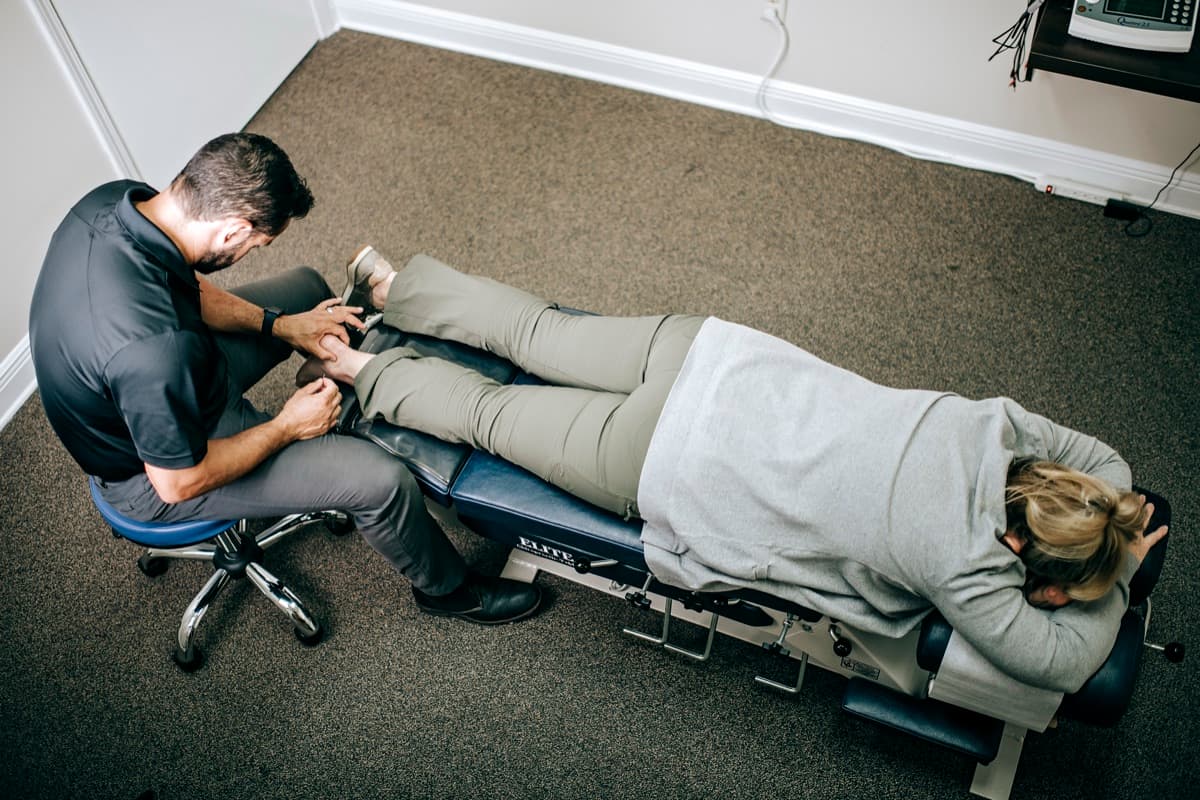
Plantar fasciitis is one of the most common complaints we see at Mayfield Advanced Chiropractic, and also one of the most undertreated. Patients typically arrive after six months of hobbling to the bathroom in the morning, trying every shoe insert sold online, and being told to stretch their calf more by whoever they managed to see.
This post is about why plantar fasciitis lingers for so many people, what actually works, and what we offer in Alexandria that genuinely moves the needle. No padding, no filler.
What Plantar Fasciitis Actually Is
The plantar fascia is a thick band of connective tissue running along the bottom of your foot, connecting the heel bone to the base of the toes. It absorbs load with every step. When that tissue is repeatedly overloaded — from a sudden jump in mileage, prolonged standing on hard floors, worn-out footwear, or poor foot mechanics — micro-tears develop at the heel insertion.
The body initiates a healing response. If the load doesn't back off, that response gets interrupted, restarts, and eventually gets stuck. The result is a chronically irritated structure that isn't acutely inflamed (which is why ibuprofen often doesn't help much) but isn't healed either. This state has a name: tendinopathy. It's the defining feature of plantar fasciitis that has been around for more than a few weeks, and it requires a fundamentally different approach than a fresh injury.
Why It Lingers
Most people chase the wrong explanation. They assume the heel hurts because of inflammation, so they rest, ice, and take anti-inflammatories. That helps in the first week or two. Once the condition is chronic — three months in, six months in — inflammation is no longer the dominant process. Degenerative tissue changes are. Rest and NSAIDs do nothing meaningful for degeneration.
The other common mistake is chasing only the symptom location. The heel is where it hurts, but the reason it's overloaded is often upstream: a tight calf and Achilles complex, restricted ankle dorsiflexion, hip weakness, or a gait compensation developed around an old knee or back problem. Treating only the heel insertion without addressing the upstream driver is the reason plantar fasciitis recurs so predictably after apparent recovery.
What We Use at Mayfield Advanced Chiropractic
We use a combination of approaches depending on how long the condition has been present and what the examination finds.
**Radial Pressure Wave Therapy (RPW)**
For chronic plantar fasciitis — anything past six to eight weeks — RPW is one of the most evidence-supported treatments available. We use the Chattanooga Intelect RPW 2, and plantar fasciitis is among the conditions with the strongest published response data for this technology. The pressure waves stimulate collagen remodeling at the fascia insertion, improve local blood flow to a chronically underperfused area, and help break up fibrotic tissue that has accumulated over months of failed healing attempts.
A course is six sessions, about a week apart, with a progress check after the third. Morning pain and walking tolerance typically improve within the first two or three treatments.
**Dry Needling**
If tight calf musculature, gastrocnemius or soleus trigger points, or posterior tibialis tension is contributing — and in most chronic cases, it is — dry needling releases those structures directly. Removing the upstream pull on the fascia changes how much load the insertion absorbs with every step.
**Chiropractic Adjustment**
Ankle and subtalar joint mobility frequently becomes restricted in people with plantar fasciitis, partly from guarding and partly from weeks or months of compensated gait. Adjustments to those joints restore mechanics and change how force distributes through the foot during loading. For some patients, restricted joints in the midfoot contribute directly to the overload pattern.
**Rehabilitation**
The evidence is clear: eccentric and isometric calf loading accelerates plantar fascia recovery and reduces long-term recurrence better than passive treatment alone. We build a home program you can do in ten minutes a day. It is not complicated, and it works. Patients who follow through recover faster and stay better longer.
What Your Evaluation Looks Like
We'll assess foot and ankle mechanics, measure ankle dorsiflexion range, palpate the fascia insertion and the calf complex, and evaluate your gait if indicated. We'll also ask how the problem started, what you've already tried, and how your activity level has changed since it began.
That picture — not just the painful heel — is what drives the treatment plan. If RPW is the right tool, you can often start the same visit. Most evaluations and first treatments run 40 to 50 minutes.
When to See Someone Else
If imaging has already confirmed a partial or complete fascial tear, or if there's a calcaneal stress fracture, we'll tell you directly that what you need is outside our scope and refer you appropriately. We don't push treatments at problems they can't solve.
For the vast majority of people with chronic plantar fasciitis, surgery is far down the decision tree. Comprehensive conservative care — done correctly, addressing both the local tissue and the upstream mechanics — resolves this condition in the great majority of cases without injections or procedures.
The Bottom Line
Plantar fasciitis is not a condition you have to live with indefinitely. It is also not one that responds to passive waiting, more of the same stretches, or another pair of inserts. If yours has been around for more than a few weeks and isn't improving, a proper evaluation is the next step — not more of what hasn't worked.
Call our Alexandria office at (318) 787-2708 or book online. We'll figure out what's actually driving the problem and build a plan around that.